 |
| Source: findingdulcinea.com, Thurgood Marshall |
Thurgood Marshall
served as a lawyer for the NAACP and worked to highlight the social injustices
that African Americans faced through the legal segregation systems in place in
the South. One of the particularly important cases Marshall argued was of
George McLaurin, an African American student who applied to a doctoral program
at the University of Oklahoma in 1948.[6]
The University of Oklahoma admitted him, but only on the grounds that he take
his classes in a separate section of the classroom, away from all of the other
students. In addition to creating a separate restroom for McLaurin, he was also
segregated from the white students while in the cafeteria and at sporting
events. McLaurin brought his case to the Supreme Court in George W. McLaurin v.
Oklahoma Board of Regents for Higher Education, and in 1950 the Supreme Court
ruled that the segregated environment “handicapped him in the pursuit of
effective graduate instruction.” This decision created great strides for the
NAACP’s cause because the decision started to break down the fundamental logic
of legal segregation. The principle of “separate but equal” was now in
question.
 |
| Source: splittingskulls.com, George McLaurin |
The
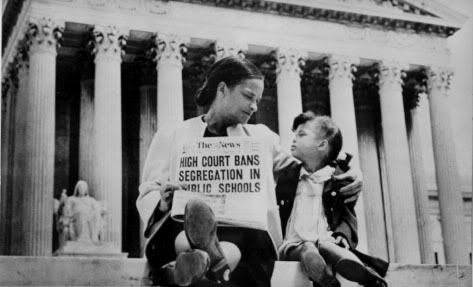
1952 case of Brown v. Board of Education of Topeka was another influential case
for the cause of the NAACP. This case centered around third-grader Linda Brown,
who was forced to attend an all black elementary school, instead of being
allowed to attend the white school that was much closer to her home.[7]
Under the legal precedence established in Plessy v. Ferguson, the segregation
of schools was legal, as long as the physical facilities provided equal
accommodations. However, Thurgood Marshall argued using evidence from
psychological studies that separate facilities between races caused feelings of
humiliation for black students, and ultimately harmed the black students’
ability to learn. In 1954, the Supreme Court decided to overturn the decision
of Plessy v. Ferguson, and in turn established that the principle of “separate
but equal” was fundamentally unequal.[8] This
decision called for the elimination of segregated schools under federal law,
but there was no way the Supreme Court to enforce this decision. Although the
NAACP had achieved a legal victory through Brown v. Board of Education, lasting
social changes were not immediate.
 |
| Source: xroads.virginia.edu, Linda Brown |
 |
| Source: dailykos.com, Linda Brown |

No comments:
Post a Comment